Pages

Thursday, October 1, 2015

13 Killed At Oregon's Umpqua Community College. Conservatives Call For More Guns

ANYWHERE, USA

Australian Gun Control After Port Arthur Massacre Left 35 Dead
http://paxonbothhouses.blogspot.com/2012/12/australian-gun-control-after-port.html

Alan: If being awash in guns were a prelude to safety, why is the United States the most dangerous developed nation rather than the least? 


Suicide And Homicide Rates Attributable To Firearms
http://www.dailymail.co.uk/news/article-2879650/Study-shows-annual-gun-deaths-United-States-catching-killed-car-crashes.html

"Gun Cartoons and Gun Violence Bibliography"

Handguns At Home And The Scourge Of Suicide Among Young People

Mom Killed By 2 Year Old Child Described As "Responsible." NOT!

80% Of All Firearm Deaths In 23 Industrialized Countries Occurred In The U.S.
http://paxonbothhouses.blogspot.com/2012/07/80percent-of-all-firearms-deaths-in-23.html

“Toy Guns Outlawed At Republican Presidential Convention. Real Guns Allowed”

13 Killed At Oregon's Umpqua Community College


At least 13 people were dead and more than 20 others were injured after a gunman opened fire Thursday morning on the campus of Umpqua Community College in southwest Oregon, authorities told NBC News.
The gunman was killed in a firefight with Douglas County sheriff's deputies, Sheriff John Hanlin said. State Attorney General Ellen Rosenblum told NBC News that 13 people were dead after the events near Roseburg, where the shootings were called in at 10:38 a.m. (1:38 p.m. ET).
No officers were injured, said Hanlin, who said: "It's been a terrible day."
Oregon Gov. Kate Brown described the gunman as a 20-year-old man and said she was immediately traveling to Roseburg, in the southwest corner of the state about 60 miles south of Eugene.
"Our top priority now is the medical treatment of the victims and the security of the campus," said Brown, who expressed "profound dismay and unimaginable heartbreak."
The FBI, the U.S. Bureau of Alcohol, Tobacco, Firearms and Explosives and the U.S. Marshals Service all joined numerous state and local agencies at the scene.
Mercy Medical Center in Roseburg said it was treating nine patients and was expecting four more. Sacred Heart General Hospital in Eugene, a major trauma center, told NBC News it was expecting three patients by helicopter.
Students told NBC News that the shootings occurred in a classroom building called Snyder Hall.
"I was walking into class, and I heard what sounded like a car backfiring," Courtney Rennie, 23, second-year human services student, told NBC News.
"You don't even think that's somebody shooting a gun," Rennie said, but "I kept envisioning someone is going to come around the corner and and shoot the windows out."
Kenny Ungerman, a Navy veteran in his first year in the school's medic program, said he had just come out of a writing class at Snyder Hall and was talking to the National Guard recruiter when "we heard a gunshot."
"It sounded like a handgun. It wasn't loud enough to be an assault rifle," Ungerman said. "Then I saw a guy with a handgun right outside — he was wearing jeans and a T-shirt. He was going toward the building, and he just disappeared into the building."
Ungerman said he heard people running and screaming, "He has a gun!" and "He's shooting!"
"I only saw him for a split second," Ungerman said.
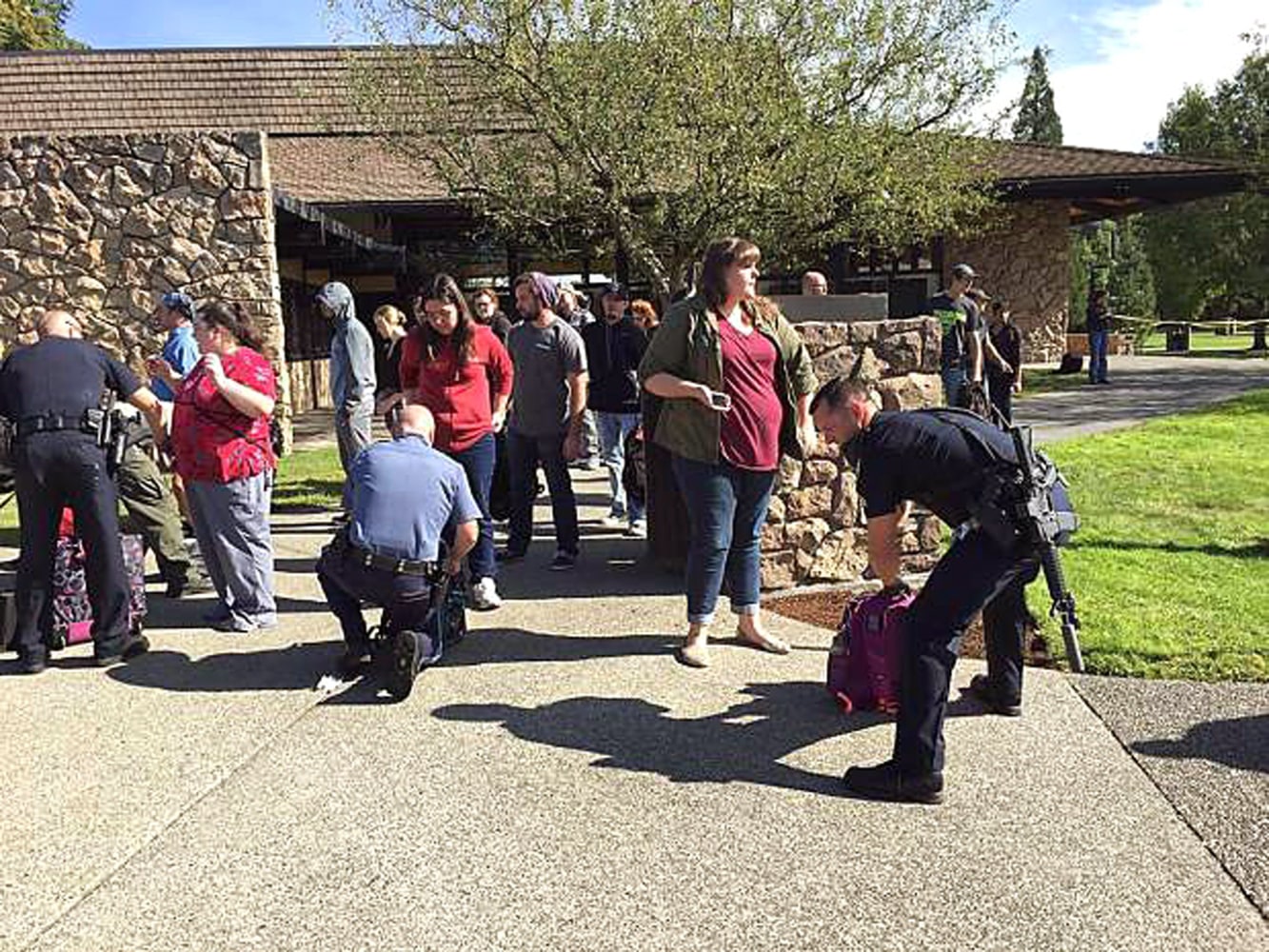
Students outside Umpqua Community College
Police search students outside Umpqua Community College in Roseburg, Ore., Thursday, Oct. 1, 2015, following a deadly shooting at the southwestern Oregon community college. Mike Sullivan / Roseburg News-Review via AP

Umpqua is a two-year school with about 3,300 full-time students and 16,000 part-time students. It started offering classes in 1961.
In a joint statement, the American Association of Community Colleges and the Association of Community College Trustees said called the shootings a "tragedy" and said they were committed to on-campus safety and security.
But "while campus safety is of the utmost priority, due to their open nature, college and university campuses are susceptible to these types of events," the organizations said.


Anybody but Hillary? The case for Biden-Warren 2016

Anybody but Hillary? 
The case for Biden-Warren 2016
Damon Linker
Six months ago, I wrote a column titled "Anybody but Hillary? The case for Warren-Webb in 2016."
Well that certainly didn't go anywhere.

Elizabeth Warren has stayed true to her word and far away from the race, while Jim Webb's campaign has gone absolutely nowhere. (Behold him languishing at under 1 percent in the polls.)

But that doesn't mean my instinct to seek out "anybody but Clinton" was wrong. On the contrary, between Hillary's inept handling of thebottomless email imbroglio, Bill's predictably defensive and passive-aggressive response to her critics, and the boatload of potential scandalslurking around in the sleaziest corners of Clintonland, I've come to view the Democratic frontrunner as a ticking time bomb for her party and the country.

That leaves Bernie Sanders as the most viable "anybody" currently in the race. But that doesn't ease my mind.

Don't get me wrong: Currently clocking in at roughly 28 percent nationally (in comparison to Hillary Clinton's 41) and leading handily in New Hampshire, Sanders is doing remarkably well. And in a campaign cycle that's seen the lefty Jeremy Corbyn wrest control of the British Labour Party from the centrist Blairites, it just might be possible for a left-leaning candidate to capture the Democratic nomination — and, who knows, even win the presidency (at least if he's pitted against one of the two guys currently leading the GOP race).

But even then I'm afraid I can't quite wrap my head around the possibility of a Sanders victory in November 2016. Why do I find it implausible? Oh, I don't know. Maybe it's because if Hollywood were looking to cast the role of a 70-something socialist union organizer on the Lower East Side of Manhattan in the early decades of the 20th century, Sanders would land the part in a heartbeat. I just don't buy that a plurality of middle-American general-election voters will cast a ballot for a guy like that. (The fact that he's also proposing a few trillion dollars' worth of new federal spending without adequately explaining where the money's going to come from doesn't thrill me either.)

As recently as a month ago, this combination of options had me feeling a little demoralized. But that was before I (along with lots of other people) began to take a second look at Joe Biden.

I'll admit, until recently I scoffed at the idea of him jumping into the race. Biden's been kicking around an awfully long time. (He first ran for president and lost in the primaries in 1988, when I was a freshman in college.) He has a history of verbal gaffes that could make a Biden presidential campaign a nightmare to run. He has his own skeletons in his closet (a plagiarism scandal in law school). He's not identified with any specific issue, agenda, or constituency. And he's no spring chicken (72 years old to Clinton's 67).

That makes him sound like a pretty weak candidate. But on a second look, I like what I'm seeing (and some of what I'm remembering).

Along with many millions of people, I was mighty impressed by Biden's mid-September interview with Stephen Colbert. Talking with frankness about his faith and how he's coped with more than his share of loss in his life — in addition to the death in May of his 46-year-old son Beau from brain cancer, his first wife and one-year-old daughter were killed in a car accident in 1972 — Biden sounded refreshingly unpolitical. He came off as charming, warm, and comfortable speaking without a script — someone who (unlike some) doesn't need to practice his authenticity.

Then there are Biden's recent statements staking out a more conflicted position on abortion than one expects to hear from such a prominent Democrat. This places him far closer to the consensus position on the issue than most leading members of his party and may indicate that he would cultivate more of a working-class, middle-American sensibility than we've seen from a Democratic presidential candidate since...well, since Jim Webb announced he was running. Yet unlike Webb, Biden seems, so far, to be pulling it off. Good for him. And good for the Democratic Party if he can run and succeed as that rarest of things — a moderate on the most divisive issue in the culture war.
On foreign policy, Biden might be even more interesting. Not many people remember it now, but back during George W. Bush's second term, Biden proposed that Iraq be broken up into three semi-autonomous regions — one Sunni, one Shiite, and one Kurdish. It was a bold proposal that was quickly forgotten once W's troop "surge" finally managed to tamp down the insurgency that was tearing the country apart at the time.

But of course the violence returned, and now we're back again to something approaching chaos, with the desert west of Baghdad serving as a home base for ISIS, the country's Sunni and Shiite populations nearly at each other's throats, and the Kurds (as always) just trying to live their lives without getting sucked into the whirlwind of violence around them. If that's not a complete vindication of Biden's proposal, which would surely have provoked its own forms of instability, it's at least refreshing evidence that he was willing to think outside the narrow, unimaginative, ideological boxes that too often determine foreign policy thinking inside the Beltway. American politics could use more of such thinking.

Finally, there's domestic policy — an area where Biden has never really stood out or distinguished himself. And that's where Warren comes in.

Biden should only jump into the race if he can persuade Warren to change her mind and take the leap with him, forming a complete ticket before the first votes are cast this winter, with the senator from Massachusetts serving as a running mate and senior domestic policy adviser in waiting. Take Biden's everyman charisma, foreign policy chops, and extensive experience as a senator and vice president, and combine it with Warren's firey, whip-smart, left-liberal populism on domestic policy and you'd have a hell of a ticket. It would be one straight out of Hillary Clinton's nightmares — and one perfectly poised to poach support from Sanders with the message, "I get why Bernie appeals to you, but we will do it better — and we can win this thing."

Put Sanders' support together with what Biden currently enjoys and you'd have a candidate with nearly 48 percent of the Democratic vote nationally to Clinton's 41 percent.

That's the contest that American politics needs — and Democratic voters deserve.


NYPD Says It Will Track Use Of Force, Actually Start Disciplining Cops

Compendium Of Pax Posts: What's Wrong With Race Relations - Hatred, Cops And The Law


NYPD Says It Will Track Use Of Force, Actually Start Disciplining Cops

“With transparency comes public understanding and with public understanding comes public support."


"Was Pope Francis Actually Swindled into Meeting Kim Davis?" Esquire

Was Pope Francis Actually 

Swindled into Meeting Kim Davis?

I spent a little time Wednesday night examining my conscience, as we used to say around the ol' confessional, as regards the meeting between Papa Francesco and noted civic layabout Kim Davis. This contemplation was prompted by two things: first, an e-conversation I had with someone who had been part of the papal travelling party and second, the appearance of E. J. Dionne on Lawrence O'Donnell's show on MSNBC. According to the first person, there were a great number of people during the pope's tour who were simply hustled in and out for informal private audiences. According to Dionne, the meeting between Davis and the pope was brokered by Archbishop Carlo Vigano, the papal nuncio to the United States at whose residence the pope stayed during his time in Washington, which is when the meeting took place. Together, these facts set off my Spidey Sense about Vatican chicanery.
Before we continue, let us stipulate a few things. First of all, let us stipulate that there are more than a few members of the Church's permanent bureaucracy, both within the Clan Of The Red Beanie and without, who are not happy that this gentleman got elected Pope, and who are not happy with what he's done and said since he was. Second, let us stipulate that many members of this group are loyal to both former pope Josef Ratzinger and, through him, to the memory (and to what they perceive as the legacy) of John Paul II who, for good and ill, had a much different idea of how to wield a papacy than Papa Francesco does. Third, let us stipulate that this opposition to the current pope has been active and vocal,to say nothing of paranoid. Finally, let us stipulate that, for over 2000 years, the Vatican has been a hotbed of intrigue, betrayal, and sanctified ratfcking on a very high scale. (It also has been a hotbed of, well, hot beds, but that's neither here nor there at the moment.) So, if you're one of these people, and you're looking to ratfck the pope's visit to the United States, and to his agenda in general, you'd be looking to put him in a box. So, how would you do that?
MORE FROM ESQUIRE

CONFIRMED: POPE FRANCIS HAD A PRIVATE MEETING WITH…

KIM DAVIS IS BASICALLY A CARTOON MONSTER, ANYWAY

MARK WAHLBERG BEGGED THE POPE TO FORGIVE HIM FOR '…

POPE: ALL CLERGY RESPONSIBLE FOR SEX ABUSE WILL BE…
Here's what  I'd do. I'd arrange for the pope to meet Davis, but not as an American culture war celebrity, but as a devout Christian whose faith is under vague assault. (I would not mention the three marriages or the fact that she took an oath before god to do her job. I mean, why burden the poor old fella with details, right?) I'd shuffle her through the process and she gets some vague words of encouragement from the pope, who otherwise doesn't know her from any other hick who gets sent his way. I'd sit on the news for the entire rest of the pope's trip, even enlisting Davis's publicity-hungry legal team in that effort.
However, as the pope is preparing to go wheels-up in Philadelphia, I'd get the word to a reporter – say, Terry Moran of ABC. On the plane ride home, Moran would ask the pope a vague question about "religious liberty," without mentioning Davis's name, which seems a curious omission for a veteran journalist to make. The pope again would give a fairly anodyne answer about freedom of conscience with which nobody can disagree. Then, with the pope safely back in Rome, I'd leak the news to a conservative Catholic website and wait for the inevitable explosion. (Implicit in this strategy are two facts: a) that the pope doesn't know who Davis is or the facts of her situation, and b) that the Vatican press office will resort to its default position of clumsy semi-stonewalling when the  story breaks.) When it comes, lo and behold, Kim Davis gets to give an exclusive interview to ABC, the same network that employs the reporter who asked the question on the airplane. But to pull this off, I'd need someone with serious clout within the Church bureaucracy. And this is where Vigano comes in.
The man is a real player within the institutional church. He first came to prominence as a whistleblowerduring one of the several investigations of the Vatican Bank, which may be what got him exiled to this godless Republic in the first place. Despite that fact, Vigano is well-known to be a Ratzinger loyalist and he always has been a cultural conservative, particularly on the issue of marriage equality. In April, in a move that was unprecedented, Vigano got involved with an anti-marriage equality march in Washington sponsored by the National Association For Marriage. (And, mirabile dictu, as we say around Castel Gandolfo at happy hour, one of the speakers at this rally was Mat Staver, who happens now to be Kim Davis's lawyer.) In short, Vigano, a Ratzinger loyalist, who has been conspicuous and publicly involved in the same cause as Kim Davis and her legal team, arranges a meeting with Davis that the legal team uses to its great public advantage. Once again paraphrasing New Orleans lawyer Lamar Parmentel fromThe Big Easy, the Vatican is a marvelous environment for coincidence.
(Also, I have been remiss in not mentioning that, because of the way John Paul II larded the cardinalate with conservatives, the pope was surrounded by conservative American clerics, including his host in Philadelphia, Charles Cardinal Chaput, who's really something of a dog's breakfast. While presiding in Denver, Chaput led the movement to deny communion to pro-choice American politicians. And, after this pope met with survivors of sexual abuse in Philadelphia, Chaput reached deeply into the Corporate Works Of Mercy to declare, "In some ways, we should get over this wanting to go back and blame, blame, blame. The church is happy to accept its responsibility, but I'm really quite tired of people making unjust accusations against people who are not to be blamed—and that happens sometimes." What a guy! As a pastor, Chaput would make a terrific collection agent.)
Ratzinger's fingerprints are all over this story. Vigano is a Benedict loyalist. Robert Moynihan, whose newsletter, Inside The Vatican, got the story first, is an actual lifelong Ratzinger protégé. And the Vatican press office acted just the way I'd want it to act, if I were the guy setting this up. First, it issues a silly non-denial denial, and then it merely confirms that the meeting occurred. At which point, the office clams up, leaving the story festering out there in the news cycle, and leaving the pope out there in the American culture war to twist in the wind. And, if this scenario is in any way accurate, it had its desired effect. The impact of what the pope actually said and did in America has been fairly well ratfcked.
Of course, this speculation depends vitally on the proposition that Papa Francesco didn't know who Kim Davis was, or anything about her current public display of faith-based goldbricking. I don't find that so very hard to believe; for all the attention it's gotten over here, it's not an international story of any consequence. (Whether he should have known about it, or have been briefed about it beforehand, is another matter entirely, as Dan Savage pointed out on Chris Hayes's program Wednesday night.)  And, it can be argued, I guess, that I'm engaging in apologetics here. But the whole thing is just a little too hinky, and I know too well how these birds operate. They've had millennia to get really good at it.

NASA Seeks Public Help To Solve Dwarf Planet Mystery

Ceres
As additional information about dwarf planet Ceres are sent back to Earth via NASA's Dawn space probe, experts become more and more baffled. With this, the space agency has announced that it now seeks public help to solve various mysteries.

NASA Seeks Public Help To Solve Dwarf Planet Mystery

By Rina Marie Doctor, Tech Times | October 1
Experts from the National Aeronautics and Space Administration (NASA) has announced on Wednesday, Sept. 30 that they are now seeking public help to solve the mysteries surrounding the dwarf planet, Ceres.
The space agency has sent Dawn, a space probe that traveled approximately three billion miles, to explore Ceres. In March 2015 or seven and a half years after its launch, Dawn has finally reached the so-called dwarf planet. Through this mission, experts are hoping to learn more about the design and composition of Ceres so as to enhance their knowledge about the structure of the Earth and other planets. However, it looks like experts are getting more and more baffled as new information are sent by Dawn.
Among the puzzling mysteries that was brought up is the presence of what experts have dubbed as the "Lonely Mountain," which is an inclined structure that measures approximately four miles in height.

Among the highest features seen by NASA's Dawn spacecraft on Ceres so far is a mountain about 4 miles (6 kilometers) high, which is roughly the elevation of Mount McKinley in Alaska. But how did it form? NASA, for now, has no idea.

"We're having difficulty understanding what made that mountain and we have been getting many suggestions from the public," Christopher Russell, principal investigator of Dawn, told reporters at a space conference in France.
Russell has received an email from a space fan, who told him that the high protrusion found in Ceres reminded him of the ice construction that he had seen when he lived in Arkansas during the early part of 2015.
According to Russell, the said ice structures began to surface by simply bulging from the ground. He added that each of the said piece had a rock or a covering of some sort that protects its outer part, helping it maintain its cool temperature. With this, he is looking at the possibility that the lonely mountain may be a type of ice structure. "We're taking suggestions like this very seriously."
The space agency has also received multiple suggestions but none has provided precise numbers.
Initially, Ceres, which orbits the sun between Jupiter and Mars, was categorized as a planet. Later on, it was regarded as an asteroid, until it has finally received the "dwarf planet" (with moon-like characteristics) label.
As Dawn captures more images of Ceres, the assumptions become increasingly weirder as well. Another unexplained mystery is the recently discovered bright spots on the surface of Ceres. The source of this white material, which was later assumed by Russell and the team as salt, has not been clearly identified and for this he apologized.
In the conference, Russell also pointed to a blue ring on the Ceres' map, saying, "We have absolutely no idea what that... is due to."
By October 2015 and towards December 2015, Dawn will be inching closer to the surface of the planet, as it embarks on its lowest and final orbit, which is about 233 miles in altitude. Through this event, experts are looking forward to learning more about Ceres.

Another Country Has Banned Adults From Smoking In Cars With Children

Smoking

Another country has banned adults from smoking in cars with children

Starting today (Oct. 1), it’s illegal in England and Wales to smoke in a car carrying someone under the age of 18.
Rolling down the window or opening the sunroof won’t cut it. The ban applies to all cars except convertibles with the top down (inadvisable most days in typical English weather).

Drivers who break the law face a £50 ($75) fine, but police acknowledge that enforcing the rule won’t be a top priority. Like the UK’s 2007 ban on smoking in indoor public places, the new smoking-in-cars law is mainly intended to influence attitudes over the long term. The percentage of smokers in the UK has fallen from 21% of the population in 2007 to around 18% last yea

Doctors welcomed the ban when Parliament passed it in February. British kids visit the doctor 300,000 times a year as a result of exposure to secondhand smoke, according to the BBC. Similar laws banning smoking in cars are in place in parts of the USCanada, and Australia.

Civil liberty advocates called it a step too far.

“Do we let the police into people’s homes where children are watching six hours’ television? Do we have the state going into kitchens to say that is one Coke can too many?” Nick Clegg, the former deputy prime minister, said of the ban last year. “I think sometimes we have to say, hang on a minute, laws and legislation is not always the solution.”

Indeed, the best-intended bans sometimes result in unintended consequences.

A year after the UK’s 2007 public smoking ban came into effect, demand was down for dry cleaners and up for chefs, as pubs scrambled to find another offering to keep customers in their chairs. And after the US passed a 2012 law mandating healthier school lunches, school meal programs across the country lost money. Children tossed more of the low-sodium, low-fat food into the garbage, or opted to bring in their own meals from home.

ViroCap Diagnostic Tool Tests For All Viruses And Can Even Differentiate Strains

Virus

With ViroCap, doctors do not have to know the virus that they are looking for making the new test valuable when the pathogen behind a disease is not known.

ViroCap Test Detects Nearly All Viruses That Infect Humans And Animals

By Rhodi Lee, Tech Times | October 1
Researchers from the Washington University in St. Louis have developed a new test capable of detecting nearly all viruses known to infect humans and animals. The test could potentially help doctors diagnose infection regardless if they do not have a clue what they are looking for.
The accuracy of the test called Virocap still needs to be tested in clinical trials so it may still take years before it can be used with patients but the technology is already made available to health service providers and researchers as it is being developed.
Thousands of viruses cause illnesses in both people and animals and this makes diagnosis difficult sometimes requiring a range of different tests. Currently available tests are not sensitive enough for detecting low levels of viral bugs or can only detect viruses that are suspected of being the cause of a patient's illness.
What make Virocap different is that physicians do not have to know what they are searching for, said pediatrics professor Gregory Storch. He added that the test can be especially helpful in situations when a pathogen behind a disease outbreak is not known or when diagnosis continues to be elusive after standard tests.
For their research, which they reported in a study published in Genome Research on Sept. 22, 2015, Storch and colleagues evaluated the Virocap test in stool, blood and nasal secretions of 14 patients.
Standard testing detected viruses in only 10 of the patients and failed to detect common viruses such as parechovirus, influenza B and herpes virus. The new test, though found the virus in the four patients that earlier testing with genome sequencing had missed.
"The test is so sensitive that it also detects variant strains of viruses that are closely related genetically," said researcher Todd Wylie, a pediatrics instructor. "Slight genetic variations among viruses often can't be distinguished by currently available tests and complicate physicians' ability to detect all variants with one test."
In another set of eight children suffering from unexplained fever, standard testing detected 11 viruses but Virocap found another seven, which includes a respiratory virus that is often harmless but can cause severe infections in some individuals.
The number of viruses that were detected in these two sets of patients increased from 21 to 32, or a jump of 52 percent.
"We have created a targeted sequence capture panel, ViroCap, designed to enrich nucleic acid from DNA and RNA viruses from 34 families that infect vertebrate hosts," the researchers wrote. "ViroCap substantially enhances Metagenomic shotgun sequencing (MSS) for a comprehensive set of viruses and has utility for research and clinical applications."