SANTA CRUZ, Bolivia —The Vatican acknowledged it
was taken by surprise to discover that a wooden hammer and sickle
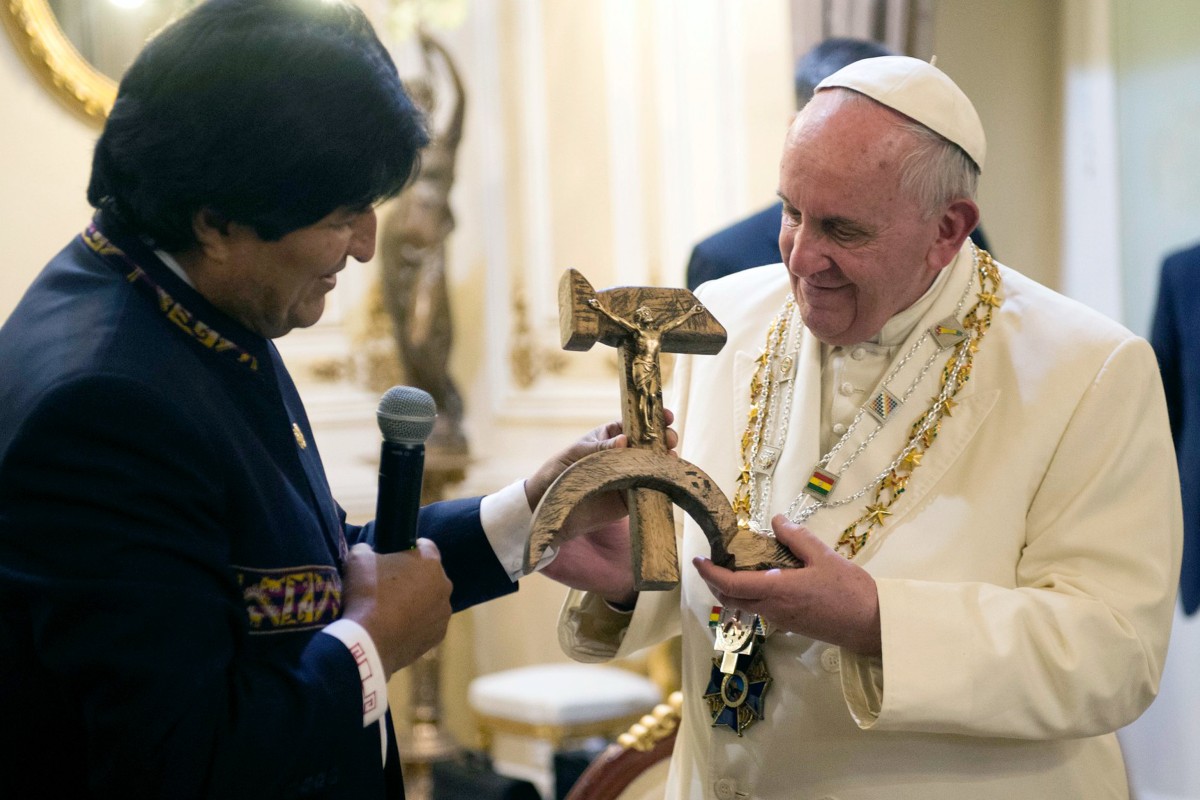
sculpture with a figure of a crucified Christ gifted to the
Pope in Bolivia was not commissioned by leftist president Evo Morales but designed by a priest killed in 1980.
The blending of the symbol of communism, under
which many Christians were persecuted in the former Soviet bloc and
still are in some communist countries, provoked outrage among Catholic
officials.
Pope Francis looked bemused when Morales, at a
meeting on Wednesday night, handed him the unusual gift, a replica of
the priest's sculpture. The Argentine-born pontiff is on the second stop
of his tour of three of the poorest South American countries.
The general interpretation was that Morales had commissioned the design of the wooden sculpture.
"The culmination of arrogance is to manipulate
God for the service of atheist ideologies," wrote Spanish bishop Jose
Ignacio Munilla on Twitter, posting a photo of Francis receiving the
gift.
Other Church officials and some Bolivian
opposition politicians accused Morales, the country's first indigenous
leader, of using the occasion to push his anti-Western views and provoke
the pope.
But as the controversy flared on Wednesday
night, Bolivian reporters said they recalled that the original author of
the sculpture was Jesuit Father Luis Espinal Camps, a strong supporter
of the rights of miners who was killed by a right-wing paramilitary
squad 35 years ago.
Shortly after his arrival in La Paz, Francis stopped to pray at the site where the priest's body was dumped along a road.
"It's true. This is something Espinal did. The
pope didn't know about it. I did not know about it. A lot of people
didn't know about it," Vatican spokesman Father Federico Lombardi said
at an unscheduled briefing on Thursday.
Lombardi, a Jesuit himself as is the pope, said
Francis had not "expressed any judgment" on the sculpture, the original
of which was made in a period when many Catholic priests were involved
in Liberation Theology movements in defense of the poor.
Juan Ramon Quintana, Morales' chief of staff,
confirmed on Thursday that the sculpture was a replica of a design
carved by Espinal. The president gave it to Francis because it shows the
Church is compatible with the communist fight for the rights of the
poor and workers, he said.
Lombardi said Bolivian Jesuits had told him the
sculpture was "not a Marxist interpretation of religion but an opening
to dialogue with others who were looking for justice and liberation."
"I don't think I would put this symbol on an altar in a church however," Lombardi said.


No comments:
Post a Comment