Pages

Tuesday, February 28, 2017

Conservative Lawmakers WILL Torpedo The Promised Repeal Of Obamacare

Conservative Lawmakers Threaten to Torpedo Obamacare Repeal


John Boehner: Repeal And Replacement Of Obamacare Is "Not What's Going To Happen"
Excerpt: "In the 25 years I served in the U.S. congress, Republicans never, ever one time agreed on what a healthcare proposal should look like. Not once." 
John Boehner

Republicans Increasingly Worried About Obamacare Repeal Without A Ready Replacement. Duh.

Alan: Crippled by "too pure principles," Republicans' only strength is ranting from the pulpit, with little (or no) ability to get things done in the mucky world of compromise and practicality.

Compendium Of Best Pax Posts On "Too Pure Principles" And The Collapse Of Conservatism

The GOP is The Party Of Simian Chest-Thumping, whose passion for ranting disguises the catastrophic disarray in which they actually live their lives. 

"Do Republicans Do Anything But Piss, Moan, Whine, Bitch?
http://paxonbothhouses.blogspot.com/2013/11/do-republicans-only-piss-moan-whine.html

Apart from "lower taxes," "a stronger military," "no hand-outs," "more personal responsibility" and impotent glorification of bygone "Golden Ages" (that never were) Republicans offer nothing that actually contributes to The Common Good or (to quote the constitution's preamble) The General Welfare.

A better healthcare system? Not a snowball's chance.

A 30 foot wall all along the Mexican border, paid for by Mexico? Not a snowball's chance.

Creating an economic boom by bringing jobs "back home?" Not a snowball's chance. 

A balanced budget? Not a snowball's chance.

No new taxes? Not a snowball's chance.

Dissolution of NAFTA? Not a snowball's chance.

Protection of American democracy from Russian meddling? Not a snowball's chance.

The complete elimination of ISIS? Not a snowball's chance.

The list of things that Trump and The Republican Party will NOT accomplish is longer than The Wall Trump won't build.

American conservatives have been lying so long they've divorced themselves from Reality.

Compendium Of Pax Posts Concerning Trump's Habitual Lying

George McGovern spotlights the failure of conservatism (except as an ideological driver) in his brilliant essay:

"The Case For Liberalism, A Defense Of The Future Against The Past"


VIDEO: Bush Weighs In On Trump Presidency, Calling Press 'Indispensable To Democracy'


Bush Weighs In On Trump Presidency, Calling Press 'Indispensable To Democracy'


Job Openings At The White House


Georgia Couple Sentenced To 35 Years For The Systematic Terrorization Perped By Deplorables

MANDATORY CREDIT; MARIETTA DAILY OUT; GWINNETT DAILY POST OUT; WXIA-TV OUT; WGCL-TV OUT

Georgia Pair Sentenced To Combined 35 Years For Terrorizing Black Child's Birthday Party

"The Deadly Oppression Of Black People: Best Pax Posts"

You Will Remember This White Woman's "F_____ Nigger" Rant The Rest Of Your Life


"Trumpcare Vs. Obamacare," The New Yorker


TRUMPCARE VS. OBAMACARE

Americans don’t want to lose the benefits they have gained, and Republicans are hearing about it.  


Atul Gawande

Image result for trump care cartoon
The pitchforks are changing hands. In 2009, it was Democratic members of Congress supporting health-care reform who were set upon by outraged constituents. When they passed the Affordable Care Act anyway, it cost their party control of Congress in the 2010 midterm elections. House Republicans subsequently voted more than fifty times to repeal or cripple the A.C.A. Nineteen Republican-led states spurned the offer of federal funds to expand Medicaid coverage. In January, Donald Trump’s first act as President was to order government agencies to avoid implementing, as much as is legally possible, what has become known as Obamacare.

But Obamacare, it turns out, has done a lot of good. It guarantees that people with preƫxisting health conditions cannot be rejected by insurers or charged more than others. It has reduced the number of uninsured people by twenty million. It has increased access to primary care, specialty care, surgery, medicines, and treatment for chronic conditions. Patients are less likely to skip needed care because of the cost. As a result, according to studies conducted at Harvard, the A.C.A. is saving tens of thousands of lives each year.

Now Republicans in Congress are facing the wrath of constituents who don’t want to lose those gains. Conservatives have had to back off from their plan to repeal Obamacare now and worry about replacement later. Instead, they must grapple with what they have tried to ignore: the complexities of our health-care system, especially in the four vital areas of employer-sponsored coverage, Medicaid, the individual insurance market, and taxes.

Half of Americans get their health coverage through their employer. For them, the A.C.A. brought such popular changes as uncapped coverage, inclusion of children up to the age of twenty-six, and requirements that insurers cover not only primary care but also pediatric dental and vision care, mental-health care, and, with no co-payments, preventive care. The Republicans probably won’t risk eliminating these provisions—except for contraceptive coverage—but they dislike the measures that have kept employers providing health benefits: tax penalties for big companies that don’t; tax credits for small businesses that do.

It was Obamacare’s dramatic expansion of Medicaid, in participating states, to all Americans living near the official poverty line that produced the largest reductions in the uninsured. Many Republicans have vowed to cut back the program’s funding, and to send the money to states as a lump sum, or “block grant.” This approach, however, is apt to throw millions out of coverage and many states into fiscal crisis, and key Republican governors and senators are opposing it.

Republicans are also divided on what to do about the roughly ten per cent of Americans—freelancers, independent contractors, and the like—who aren’t covered by an employer, don’t qualify for Medicare or Medicaid, and must rely on the individual health-insurance market. Before the A.C.A., these people were the most vulnerable in the system; twenty-seven per cent of non-elderly adults have a preĆ«xisting condition that makes them effectively uninsurable without the law’s protections. Now they can sign up through online exchanges for plans that are priced without regard to health history and are subsidized based on income.

Republicans claim that the program is in a death spiral. It isn’t; enrollment has held constant. But there is a need to draw in younger, healthier people to offset the costs of older, sicker people and keep the premiums steady. Doing so depends on promoting HealthCare.gov widely and enforcing the tax penalty for people who don’t sign up. The President, however, has issued a raft of contradictory directives that ultimately instruct the government to do neither. As a result, more and more insurers are saying that they will pull out of the exchanges, risking the collapse of the individual market.

Having promised to get rid of the insurance mandate, Republicans are considering alternatives, but so far they are all inadequate. A requirement for people to maintain “continuous coverage”—to take an example supported by the new Secretary of Health and Human Services, Tom Price, and Speaker of the House Paul Ryan—would mean that people who lose their insurance temporarily, because they, say, change jobs or suffer a financial setback, would also lose their preĆ«xisting-condition protections. For these people and for others left behind, Price and Ryan advocate state-run “high-risk pools.” But, in the thirty-five states that offered high-risk pools to the uninsurable before the A.C.A., inadequate funding delivered terrible coverage, with extremely high premiums and deductibles, and annual limits as low as seventy-five thousand dollars.

Hardly anyone signed up.

For orthodox Republicans, the central issue is, of course, taxes. Obamacare increased them, particularly for high-income individuals and for industries that profit from the expansion of coverage, to pay for the costs of reform. (The A.C.A. actually reduces the deficit.) Many Republicans have made cutting those taxes their top priority; others see preserving coverage as the imperative. Each side thinks the other is committing political suicide. But, with so many Americans beginning to recognize how much they stand to lose, the political equations are shifting.

Governance is forcing Republicans to confront the reality that repeal without replacement is untenable. In a stalemate, Congress would likely need to delay repeal and, to reassure skittish insurers, focus on small-scale repairs, such as affirming that subsidies will continue to be funded, and either enforcing the existing mandate or revising it so that more young and healthy people sign on. (For instance, healthy people could be charged an extra ten per cent on premiums if they forgo insurance for a year, the same as the penalty for elderly people who refuse Medicare Part B.) In addition, the states that sat out the Medicaid expansion in order to thwart President Obama would be free to join in under a Republican Administration, as many would like to. “Insurance for everybody,” Trump has vowed. A Trumpcare compromise could yet bring us a step closer to it.

But legislators have no time to waste. Insurers must decide by April whether to offer a plan for the exchanges in 2018, and at what price. That requires certainty about the future. Pitchforks have their uses, but crafting health-care policy calls for more delicate instruments. The basic functioning of the health-care system is at stake. So are American lives. 


Monday, February 27, 2017

Unrepentant Theocrats In Michigan Seek Church-State Union – And Monarchy

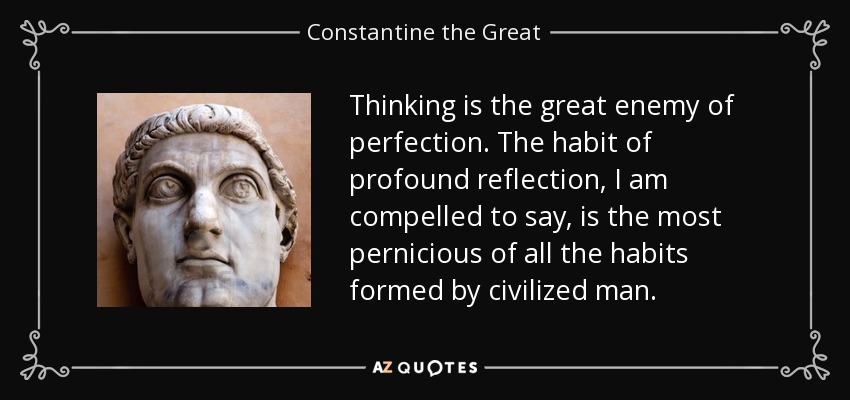
Image result for constantine quotes

Donald Trump: "I love the uneducated."

Unrepentant Theocrats In Michigan Seek Church-State Union – And Monarchy

Feb 24, 2017 by Rob Boston in Wall of Separation
Stephen K. Bannon, a controversial adviser to President Donald J. Trump, yesterday laid out his plan to “deconstruct” (read: destroy) government during a speech to the Conservative Political Action Conference.
The idea that you can simply blow up a government agency or program  – even if it has been around for a long time, even if it works and even if people rely on it – seems to be much in vogue in right-wing quarters these days. Sadly, Bannon is far from the only one out there bent on nihilistic destruction.
The Detroit Free Press recently ran a story about what it described as a Catholic “fringe group” that also want to lay things to waste. This group, called Church Militant, has ambitious goals: It wants to tear down the wall of separation between church and replace our democracy with a far-right Catholic king who will decide what’s best for us.
But if it can’t get a king, Church Militant is willing to settle for Trump.
Medieval kings make great characters in an HBO series, but they weren't  so cool in real life.

The organization, headed by an “ex-gay” man named Michael Voris, runs a website and TV station. These vehicles, Voris hopes, will bring everyone into line with his version of Catholicism. Strangely, he seems to believe that Trump, a nominal Presbyterian not known for his piety, will lead the way.
I’ve wondered how religious zealots could line up behind Trump, a clearly amoral man who’s biblically illiterate and whose idea of a spiritual adviser is a money grubbing Prosperity Gospel preacher named Paula White.
The Free Press story sheds some light on that: You see, God sometimes uses bad people for his own ends.
Voris cites Constantine the Great, the fourth-century Roman emperor who began the process of Christianizing the Western world, as an example. Constantine, Voris asserts, was “not a moral man” and a “power-hungry egomaniac” – but none of that matters because the things he did helped the church.

Constantine the Great, aka St. Constantine (Wikipedia Excerpt)

Executions of Crispus and Fausta[edit]

On some date between 15 May and 17 June 326, Constantine had his eldest son Crispus, by Minervina, seized and put to death by "cold poison" at Pola (PulaCroatia).[248] In July, Constantine had his wife, the Empress Fausta, killed in an over-heated bath.[249] Their names were wiped from the face of many inscriptions, references to their lives in the literary record were erased, and the memory of both was condemned. Eusebius, for example, edited praise of Crispus out of later copies of his Historia Ecclesiastica, and his Vita Constantini contains no mention of Fausta or Crispus at all.[250] Few ancient sources are willing to discuss possible motives for the events; those few that do offer unconvincing rationales, are of later provenance, and are generally unreliable.[251] At the time of the executions, it was commonly believed that the Empress Fausta was either in an illicit relationship with Crispus, or was spreading rumors to that effect. A popular myth arose, modified to allude to HippolytusPhaedra legend, with the suggestion that Constantine killed Crispus and Fausta for their immoralities.[252] One source, the largely fictional Passion of Artemius, probably penned in the eighth century by John of Damascus, makes the legendary connection explicit.[253] As an interpretation of the executions, the myth rests on only "the slimmest of evidence": sources that allude to the relationship between Crispus and Fausta are late and unreliable, and the modern suggestion that Constantine's "godly" edicts of 326 and the irregularities of Crispus are somehow connected rests on no evidence at all.[252]
Although Constantine created his apparent heirs "Caesars", following a pattern established by Diocletian, he gave his creations a hereditary character, alien to the tetrarchic system: Constantine's Caesars were to be kept in the hope of ascending to Empire, and entirely subordinated to their Augustus, as long as he was alive.[254] Therefore, an alternative explanation for the execution of Crispus was, perhaps, Constantine's desire to keep a firm grip on his prospective heirs, this—and Fausta's desire for having her sons inheriting instead of their half-brother—being reason enough for killing Crispus; the subsequent execution of Fausta, however, was probably meant as a reminder to her children that Constantine would not hesitate in "killing his own relatives when he felt this was necessary".[255]
“The personal proclivities, the personal sins or life of a particular leader is a separate discussion from how that man’s view of the world might influence his policies,” Voris remarked. “And if that policy is favorable to the church, well then, very good.”
This is the sort of thinking that leads religious leaders to embrace dictators, strongmen and autocrats. It persuades them to trade their souls for a few policy crumbs. It convinces them that the government doesn’t have to respect the right of conscience.  
That way lies madness. The idea that church and state can combine and force people to adopt certain theological beliefs has been tried over and over again. Every time it spawns persecution, terror and death. As a traditionalist Catholic, Voris must know some things about church history and how badly efforts to impose a rigid orthodoxy have turned out – the Crusades and the Inquisition come to mind – yet he continues to insist that Trump can lead the way to some sort of “moral” (and apparently uber-Catholic) country. Really.
What would this government-imposed religious uniformity look like in modern-day, pluralistic America? For starters, women aren’t going to have any reproductive freedom, and LGBTQ rights will be obliterated. Religious freedom, especially as it applies to Muslims, whom Voris and his network seem to despise, will be a memory.
The secular state? Forget it. Here’s what Voris has to say about that: “The problem with America is America never sat down and had the right discussion about which religion is the right religion.”
A few years ago, Voris released a video in which he said, “The only way to run a country is by benevolent dictatorship, a Catholic monarch who protects his people from themselves and bestows on them what they need, not necessarily what they want.” He asserts that Americans today live under a “secular dictatorship” and insists that morals are found in his version of Catholicism “more perfectly than any other” belief system.
These theocrats alternately amuse and horrify me. They’re all convinced only they have the “right” religion, only they have correctly interpreted a holy book – be it Christian, Muslim, Hindu, etc. Hundreds of fundamentalist denominations claim to be the one and only true path to salvation. The problem with that is obvious.
I should note that officials with the Catholic Church keep Voris and his group at more than arm’s length. The Archdiocese of Detroit has issued statements disavowing Church Militant, and Voris is banned from speaking in local Catholic parishes.
It’s not hard to understand why. Voris’ group is truly a fringe movement – albeit one with a few hundred thousand followers on Facebook and what the Free Press calls "a multimedia empire." But despite their reliance on modern technology, these extremist theocrats are parroting a view straight from the Middle Ages.  
Instead of pining for the 12th century, let’s celebrate America’s achievement: absolute freedom of conscience resting on a wall of separation between church and state.
In fact, do more than celebrate it. Vow to defend it against the “deconstructionists” who lust to destroy it.  

Truman, Trump, Repression And Terror

Image may contain: 1 person, eyeglasses and text