Pages

Saturday, November 30, 2013

Pope Francis Expresses Economic Views Of Karl Polanyi

Pope Francis and, clockwise from top left: Keynes, Polanyi, Hayek, and Marx 

***

Karl Polanyi

***

It would make for some pretty amazing headlines if Pope Francis turned out to be a Marxist.

Between his hints at rehabilitating liberation theology—condemned by his predecessors—and talk about casting off "the economic and social structures that enslave us," Marxism isn't totally out of the question.

But happily for nervous church leaders, Francis's first Apostolic Exhortation, issued Tuesday, doesn't quite suggest someone who would get "Marx" in an Internet-style "Which Economic Theorist Are You?" quiz. Granted, he wouldn't exactly get Friedrich von Hayek or Ayn Rand, either.

But you know whom he might plausibly be matched with, though? A favorite political economist of anti-free market academics: Karl Polanyi.

Karl Polanyi is most famous for his book The Great Transformation, and in particular for one idea in that book: the distinction between an "economy being embedded in social relations" and "social relations [being] embedded in the economic system." 

Polanyi's Big Idea: The Economy Has to Serve Society, Not the Other Way Around


Economic activity, Polanyi says, started off as just one of many outgrowths of human activity. And so, economics originally served human needs. But over time, people (particularly, policy-making people) got the idea that markets regulated themselves if laws and regulations got out of their way. The free market converts told people that "only such policies and measures are in order which help to ensure the self-regulation of the market by creating the conditions which make the market the only organizing power in the economic sphere." Gradually, as free market-based thinking was extended throughout society, humans and nature came to be seen as commodities called "labor" and "land." The "market economy" had turned human society into a "market society."

In short (as social sciences professors prepare to slam their heads into their tables at my reductionism), instead of the market existing to help humans live better lives, humans were ordering their lives to fit into the economy.

What Pope Francis Said
Now, back to the pope. Pope Francis, in his exhortation, notably does not call for a complete overhaul of the economy. He doesn't talk revolution, and there's certainly no Marxist talk of inexorable historical forces.

Instead, Francis denounces, specifically, the complete rule of the market over human beings—not its existence, but its domination.

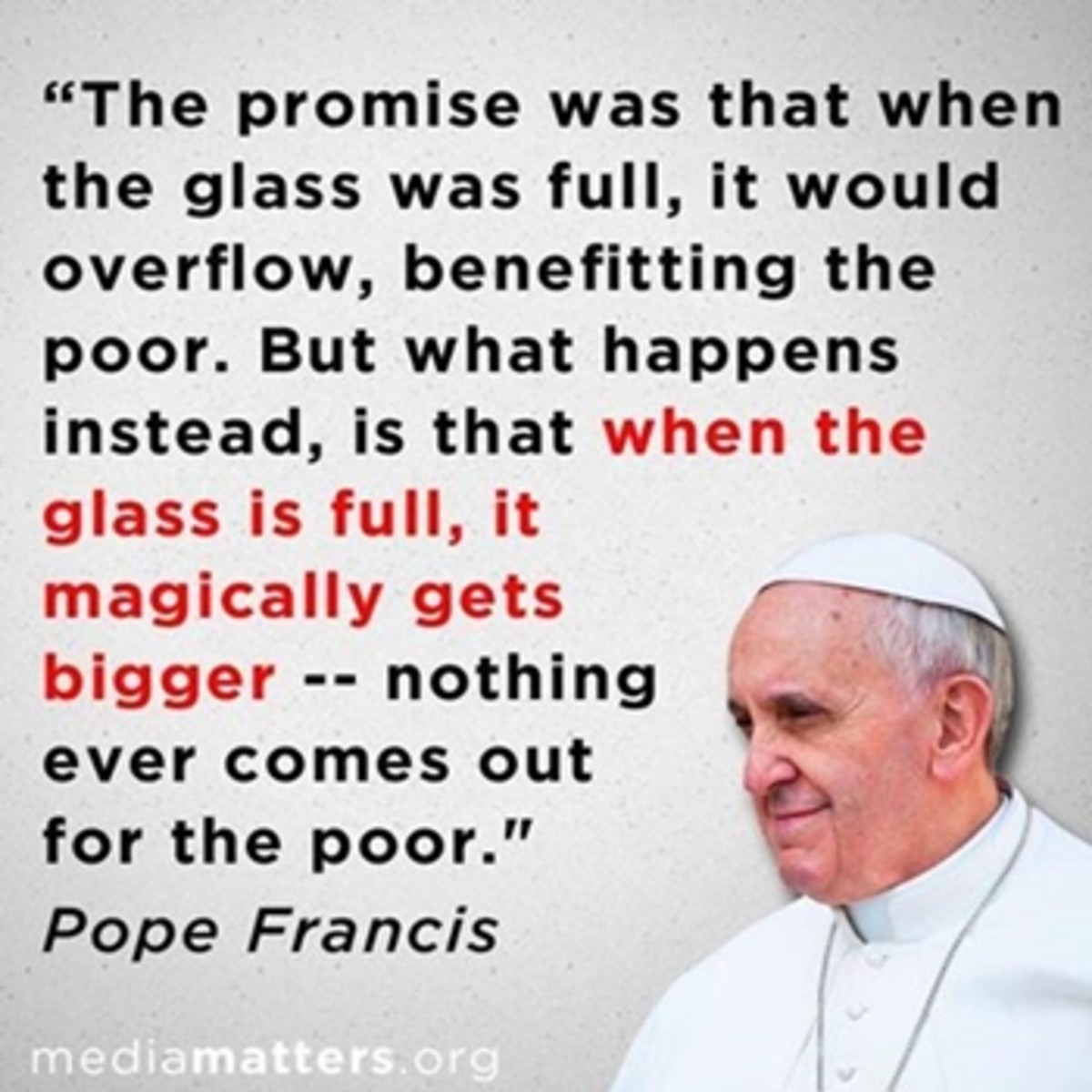
"Today everything comes under the laws of competition and the survival of the fittest," he writes. "Human beings are themselves considered consumer goods to be used and then discarded," and "man is reduced to one of his needs alone: consumption." He rejects the idea that "economic growth, encouraged by a free market, will inevitably succeed in bringing about greater justice and inclusiveness in the world." Instead, he argues, growing inequality is "the result of ideologies which defend the absolute autonomy of the marketplace and financial speculation," which "reject the right of states, charged with vigilance for the common good, to exercise any form of control." And he repeats the exact language he used in an early address: "Money must serve, not rule!"

Seeing the similarities yet?

Polanyi, the Pope, and Blaming the Market for Big Crises

Where things get really interesting is when Pope Francis brings up the financial crisis. "One cause of this situation," he writes, "is found in our relationship with money, since we calmly accept its dominion over ourselves and our societies. The current financial crisis can make us overlook the fact that it originated in a profound human crisis: the denial of the primacy of the human person!"

It's nothing new to say the financial crisis came from a lack of regulation. That's a fairly popular analysis. But what Pope Francis is saying is more Polanyan, hearkening back to the idea that the tipping point has to do with the relationship between the market and society/humanity, and which is subordinate to the other. Just as Polanyi argued that the extension of the market economy across the globe (through the gold standard) was the root cause of World War I (and you'll have to go back to the original book for that, but it's a beautifully, hilariously gutsy, Guns, Germs, and Steel kind of argument), Francis is arguing that failing to keep humanity at the center of our economic activity was the root cause of the financial crisis.

A Vision for the Future

One of the tricky and crucial parts of Polanyi's argument is that he doesn't actually believe (at least, back in the 1940s, when he was writing) that we're living in a world where the economy has become fully disembedded from society. This "Utopia," he writes, that many economic theorists and policymakers are foolishly striving for, "could not exist for any length of time without annihilating the human and natural substance of society; it would have physically destroyed man and transformed his surroundings into a wilderness."


HEATHER HORN is a senior associate editor at The Atlantic. She is a former features editor and staff writer for The Atlantic Wire, and was previously a research assistant at the Carnegie Endowment for International Peace.


Sorry Folks, Rich People Don't Actually "Create Jobs"

180911676

An Occupy Wall Street protester dressed as Robin Hood participates in a march on September 17, 2013 in New York City.
***
"Republican Rule and Economic Catastrophe: A Lockstep Relationship"
http://paxonbothhouses.blogspot.com/2012/05/republican-rule-and-economic.html
***

This post originally appeared in Business Insider.
As America struggles with high unemployment and record inequality, everyone is offering competing solutions to the problem. In this war of words (and classes), one thing has been repeated so often that many people now regard it as fact. "Rich people create jobs." Specifically, by starting and directing America's companies, rich entrepreneurs and investors create the jobs that sustain everyone else. This statement is usually invoked to justify cutting taxes on entrepreneurs and investors.  If only we reduce those taxes and regulations, the story goes, entrepreneurs and investors can be incented to build more companies and create more jobs.
This argument ignores the fact that taxes on entrepreneurs and investors are already historically low, even after this year's modest increases. And it ignores the assertions of many investors and entrepreneurs (like me) that they would work just as hard to build companies even if taxes were higher. But, more importantly, this argument perpetuates a myth that some well-off Americans use to justify today's record inequality—the idea that rich people create jobs.
Entrepreneurs and investors like me actually don't create the jobs—not sustainable ones, anyway. Yes, we can create jobs temporarily, by starting companies and funding losses for a while. And, yes, we are a necessary part of the economy's job-creation engine. But to suggest that we alone are responsible for the jobs that sustain the other 300 million Americans is the height of self-importance and delusion.
So, if rich people do not create the jobs, what does? A healthy economic ecosystem—one in which most participants (the middle class) have plenty of money to spend. Over the last couple of years, a rich investor and entrepreneur named Nick Hanauer has annoyed all manner of rich investors and entrepreneurs by explaining this in detail. Hanauer was the founder of online advertising company aQuantive, which Microsoft bought for $6.4 billion. What creates a company's jobs, Hanauer explains, is a healthy economic ecosystem surrounding the company, which starts with the company's customers.
The company's customers buy the company's products. This, in turn, channels money to the company and creates the need for the company to hire employees to produce, sell, and service those products. If the company's customers and potential customers go broke, the demand for the company's products will collapse. And the jobs will disappear, regardless of what the entrepreneurs or investors do.
Now, again, entrepreneurs are an important part of the company-creation process. And so are investors, who risk capital in the hope of earning returns. But, ultimately, whether a new company continues growing and creates self-sustaining jobs is a function of the company's customers' ability and willingness to pay for the company's products, not the entrepreneur or the investor capital. Therefore, as Hanauer argues, suggesting that rich entrepreneurs and investors create jobs is like suggesting that squirrels create evolution.
Or, to put it even more simply, it's like saying that a seed creates a tree. The seed does not create the tree. The seed starts the tree. But what actually grows and sustains the tree is the combination of the DNA in the seed and the soil, sunshine, water, atmosphere, nutrients, and other factors that nurture it. Plant a seed in an inhospitable environment, like a desert or Mars, and the seed won't create anything. It will die.
So, then, if what creates the jobs in our economy is, in part, "customers," who are these customers? And what can we do to make sure these customers have more money to spend to create demand and, thus, jobs? The customers of most companies are ultimately American's gigantic middle class—the hundreds of millions of Americans who currently take home a much smaller share of the national income than they did 30 years ago, before tax policy aimed at helping rich people get richer created an extreme of income and wealth inequality not seen since the 1920s.
America's middle class has been pummeled, in part, by tax policies that reward "the 1 percent" at the expense of everyone else. It has also been pummeled by globalization and technology improvements, which are largely outside of any one country's control. The prevailing story that justifies tax cuts for America's entrepreneurs and investors is that the huge pots of gold they take home are supposed to "trickle down" to the middle class and thus benefit everyone. Unfortunately, that's not the way it actually works.
First, America's companies are currently being managed to share the least possible amount of their income with the employees who help create it. Corporate profit margins are at all-time highs, while wages are at an all-time low.
Second, as Hanauer observes, America's richest entrepreneurs, investors, and companies now have so much money that they can't possibly spend it all. So instead of getting pumped back into the economy, thus creating revenue and wages, this cash just remains in investment accounts. Hanauer explains why. Hanauer takes home more than $10 million a year of income. On this income, he says, he pays an 11 percent tax rate. (Presumably, most of the income is dividends and long-term capital gains, which carry a tax rate of about 20 percent. And then he probably has some tax shelters that knock the rate down the rest of the way).
With the more than $9 million a year Hanauer keeps, he buys lots of stuff. But, importantly, he doesn't buy as much stuff as would be bought if his $9 million were instead earned by 9,000 Americans each taking home an extra $1,000 a year. Why not? Because, despite Hanauer's impressive lifestyle—his family owns a plane—most of the $9 million just goes straight into the bank (where it either sits and earns interest or gets invested in companies that ultimately need strong demand to sell products and create jobs). For example, Hanauer points out that his family owns only three cars, not the 3,000 cars that might be bought if his $9 million were spread out over a few thousand families.
If that $9 million had gone to 9,000 families instead of Hanauer, it would almost certainly have been pumped right back into the economy via consumption (i.e., demand). And, in so doing, it would have created more jobs. Hanauer estimates that, if most American families were taking home the same share of the national income that they were taking home 30 years ago, every family would have another $10,000 of disposable income to spend. That, Hanauer points out, would have a huge impact on demand—and thereby, job creation.
So, if nothing else, it's time we stopped perpetuating the fiction that "rich people create jobs." Rich people don't create jobs. Our economy creates jobs. We're all in this together. And until we understand that, our economy is going to go nowhere.

Amish Girl with Leukemia, Family Flees US to Avoid Chemotherapy

AKRON, Ohio -- A 10-year-old Amish girl with leukemia and her parents have left the country to seek alternatives to chemotherapy, according to the family's attorney.

***

"In The Name Of God:
The True Story of the Fight to Save Children from Faith-Healing Homicide"

***

Sarah Hershberger and her parents oppose chemotherapy, and have been fighting the Akron Children's Hospital in court after the family stopped Sarah's treatment. Her parents said the treatments have caused their daughter a great deal of pain, and they'd rather focus on herbal and natural remedies.

"It's the constitutional right, but [there's a] moral right to refuse conventional medical treatment," the Hershberger's attorney, Maurice Thompson, told ABC News Wednesday.

Hospital officials declined to comment on Sarah's case or whether they would seek further legal action. Law enforcement officials said at this point there was no formal search for the girl.

The Hershbergers left their home in northeast Ohio days before a state appeals court appointed a guardian in October to take over medical decisions from Sarah's parents. The family members won't say where they are now, but they have no plans to return to their home anytime soon, according to Thompson.

"Sarah's condition has gotten a lot better since the family has been pursuing the alternative treatment," Thompson said.

Sarah had tumors on her neck, chest and kidneys when her parents initially agreed to chemotherapy at Akron Children's Hospital earlier this year. Her parents said the side effects were terrible, and they wanted to treat Sarah's leukemia with alternative treatments.

"We've seen how sick it makes her," Andy Hershberger, Sarah's father, told ABC News in August. "Our belief is the natural stuff will do just as much as that stuff if it's God's will."

The Hershbergers said their daughter complained to them that the chemo made her tired and sick.

"If we do chemotherapy and she would happen to die, she would probably suffer more than if we would do it this way and she would happen to die," he said.

The legal wrangling over Sarah's health began in July when the hospital took the family to court to seek temporary guardianship. The judge in Ohio's Medina County ruled that Sarah's parents had the right to make medical decisions for her, because there was no evidence they are unfit.

An Ohio appeals court ruled in August that a juvenile court judge must reconsider the decision that blocked the hospital's attempt to give the attorney limited guardianship over Sarah and the power to make medical decisions for her.

An appeals court ruling in October granted an attorney, who's also a registered nurse, limited guardianship over Sarah and the power to make medical decisions for her. The court said the beliefs and convictions of her parents can't outweigh the rights of the state to protect the child.

Copyright 2013 ABC News Radio

"Save America: Restore The Draft," By Dana Milbank


At this time of Thanksgiving, I’m grateful for the U.S. military — not just for the usual reason that it protects us from our foes but also because it has the potential to save us from ourselves.
As I make my rounds each day in the capital, chronicling our leaders’ plentiful foibles, failings, screw-ups, inanities, outrages and overall dysfunction, I’m often asked if there’s anything that could clean up the mess.
Dana Milbank
Dana Milbank writes a regular column on politics.

My usual answer is a shrug and an admission that there’s no silver bullet. There are many possibilities — campaign spending limits, term limits, nonpartisan primaries, nonpartisan redistricting, a third party — but most aren’t politically or legally feasible, might not make much of a difference or, as with Harry Reid’s rewriting of Senate rules, have the potential to make things even worse.
But one change, over time, could reverse the problems that have built up over the past few decades: We should mandate military service for all Americans, men and women alike, when they turn 18. The idea is radical, unlikely and impractical — but it just might work.
There is no better explanation for what has gone wrong in Washington in recent years than the tabulation done every two years by the American Legion of how many members of Congress served in the military.
A Congressional Quarterly count of the current Congress finds that just 86 of the 435 members of the House are veterans, as are only 17 of 100 senators, which puts the overall rate at 19 percent. This is the lowest percentage of veterans in Congress since World War II, down from a high of 77 percent in 1977-78, according to the American Legion. For the past 21 years, the presidency has been occupied by men who didn’t serve or, in the case of George W. Bush, served in a capacity designed to avoid combat.
It’s no coincidence that this same period has seen the gradual collapse of our ability to govern ourselves: a loss of control over the nation’s debt, legislative stalemate and a disabling partisanship. It’s no coincidence, either, that Americans’ approval of Congress has dropped to just 9 percent, the lowest since Gallup began asking the question 39 years ago.
Because so few serving in politics have worn their country’s uniform, they have collectively forgotten how to put country before party and self-interest. They have forgotten a “cause greater than self,” and they have lost the knowledge of how to make compromises for the good of the country. Without a history of sacrifice and service, they’ve turned politics into war.
Alan: Two years of obligatory national service in the new-and-improved Peace Corps (or even the old-and-unimproved Peace Corps) will do more for self-discipline and putting-mission-ahead-of-self-interest than stupid wars like Iraq and Vietnam that end with shell-shocked thousands and chest-thumping jingoism ahead of country. Two years of obligatory national service in the new-and-improved Peace Corps will create such widespread nurturance of benevolent foreign policy that millions of new "ambassadors" will diminish Uncle Sam's drum-banging.
Compulsory military service, as old as Athenian democracy and common in countries such as Israel that live under threat, has been in decline in Western Europe since the end of the Cold War. But an exception, Switzerland, is instructive: On Sept. 22, the Swiss voted 73 percent to 27 percent to keep their conscription army. It has less to do with security than with national identity in a land of 26 cantons and four official languages. The government argued that military service teaches people “how to live and work with compatriots from all regions, all linguistic groups and all social strata,” which “contributes enormously to the national cohesion.”
In Switzerland, the sons of bankers and farmers alike do basic training for several months and then are recalled to service for brief periods. But the structure is less important than the service itself. My former colleague Tom Ricks proposes bringing back the draft in the United States but allowing for a civilian national service option — teaching, providing day care and the like — for those who don’t want to join the military. 
Alan: Tom Ricks' idea is kin to a suggestion set forth in "Proposal For Two Years Of Obligatory National Service."  http://paxonbothhouses.blogspot.com/2012/07/proposal-for-two-years-of-obligatory.html
There’s no mass movement for mandatory service, but the idea has gained a diverse group of supporters, including retired Gen. Stanley McChrystal and Rep. Charlie Rangel (D-N.Y). Gun-rights groups would cheer an armed citizenry, and an article published by the libertarian Cato Institute argued that compulsory service “can be a pillar of freedom.”
The costs would be huge. But so would the benefits: overcoming growing social inequality without redistributing wealth; making future leaders, unlike today’s “chicken hawks,” disinclined to send troops into combat without good reason; putting young Americans to work and giving them job and technology skills; and, above all, giving these young Americans a shared sense of patriotism and service to the country.
It would take some time, but this new generation of Americans, once again asking what they can do for their country, would undo much of the damage today’s crop of self-interested leaders is doing to our politics.

Shields and Brooks: Pope Francis' Critique Of Capitalism

Shields and Brooks on the pope's critique of capitalism, Thanksgiving gratitude

SUMMARY

Syndicated columnist Mark Shields and New York Times columnist David Brooks join Hari Sreenivasan to discuss the week's top news, including the short-term Iran nuclear agreement, the pope's writings on capitalism, proposed changes to campaign finance rules and things to be grateful for.


HARI SREENIVASAN: And to the analysis of Shields and Brooks. That's syndicated columnist Mark Shields and New York Times columnist David Brooks.
So, while you were out last weekend, there was some news. The Iran deal happened. We did cover it on the NewsHour Weekend, but you didn't have a chance to weigh in.

MARK SHIELDS: 
It's a better deal than where we were, in the sense that six months, and there's a -- I think it's confidence-building on both sides, in a place where there was little to no confidence on either side. And I think the inspections are positive, and the alternate is unspeakable.So, let's get to it. Is this a good deal?
DAVID BROOKS: I have got ambivalence of mountain -- mountain-size proportion about this thing.
I think, on balance, it's probably worth an attempt, because I really think thought they were heading towards nuclear weapons. And I think still think that is probably the likely outcome. Nonetheless, this is a shot. But it all depends on how tough we are in following up.
RELATED INFORMATION
The Doubleheader: Shields and Brooks on Rivalry Saturday
This is a six-month thing that is up to lead up to a bigger thing. But do we actually -- and the administration has begun to do this, in part through a column that David Ignatius wrote, laying out exactly what they consider criteria for a good final deal. And if they stick to that criteria, rather than folding, then -- then you really could get there somewhere.
And the second thing we really have to be tough on, the Iranians are counting on us, or the entire world, that the sanction regimes will begin to dissolve, that once companies get the chance to make some money in Iran, it will all fall apart. Somehow, if the Western alliance can really hold the sanctions together, then this is a worth -- a risk worth taking.
Both those are big ifs, though.
HARI SREENIVASAN: What do you -- what -- do you think the alliance can hold it together there?
MARK SHIELDS: I think it can.
I think that the president is obviously all in on this. And I think one of the problems he does face is that the Congress is going to try and push harder for sanctions. He's got to stop those in the short-term, and at least get his six months. And I think they have been doing a good job so far in trying to tamp down the understandable criticism and opposition.
But I just think that we -- we -- there's been an overreaction on the opposition's side. The idea of comparing this to Munich 1938 is beyond overblown. Iran in 2013, whatever it is, and it's not a very pleasant place, is not Nazi Germany in 1938. And I -- so I think this is -- I think it's worth it, and I'm just hoping.
DAVID BROOKS: Yes.
The Saudis -- though, to be fair, the Saudis are really upset. The Gulf states are really upset. The Israelis are really upset. The people who are most vulnerable to an Iranian nuclear weapon are really upset. And that, to me, is to be trusted. It seems unlikely that a regime that went so far to get a nuclear weapon is suddenly going to pull back and give it up.
HARI SREENIVASAN: What about the congressional variable here? What if Congress decides to slap on new sanctions that really makes this...
MARK SHIELDS: Well, I think this is a real test of the president's political leadership in the country, as well as with the Congress.
And it obviously is tougher now that his numbers are down. But I think only the president can lay out the stakes, and that is a six-month period. What -- and it comes down to what the alternative is. I mean, if we think that, in isolation, they weren't developing, if the people who were convinced of that, and I don't understand their skepticism -- I can understand their skepticism. I don't understand their opposition to an attempt now to freeze it and with total inspection every day.
DAVID BROOKS: Well, sanctions are working. And if sanctions are working, maybe more sanctions are good.
I happen to think the confluence of events of sort of the deal, the offer from the Obama administration, which is the carrot, and the stick from the Congress, is a pretty good balance. So, if they want to be tough while Obama is being open, that sends the right signal to the Iranians.
HARI SREENIVASAN: OK. Let's shift gears.
The pope came out with -- I want to get this correct -- his first apostolic exhortation. It was his first major work, big report. In there, he takes quite a few very specific jabs at capitalism, calling it a new tyranny. I mean, popes in the past have had these concerns before, but really he's laying this out. And some of the sort of pope watchers, experts are saying that this is the agenda for how to reform the Christian church.
DAVID BROOKS: Yes, well, I -- I actually have a lot of sympathy.
I'm a fan of capitalism, but I have a lot of sympathy for it. And it should be remembered that Benedict and John Paul II issued some extremely critical statements on capitalism. That is the job of the Catholic Church, to be a balance to the materialistic drives of our culture and of economy.
I guess I would wish he would emphasize two things, first, that capitalism over the last 25 years has been an incredible moral good. It has reduced poverty more in the last 25 years than ever before in human history, mostly in Asia. But that's been a phenomenal good. That's relieved suffering. And that has been a product of capitalism.
The second thing I would say is sometimes I think the analysis and some of the language used this time was too narrowly economic. One of the things capitalism does is, it does enhance and exacerbate the sin of pride, making yourself, the material world the center of your universe, instead of God's will.
But the doesn't only happen in capitalism. That can happen in faculty clubs. It can happen at NGOs. And so that is a spiritual sin. And to talk about some of the spiritual sins that capitalism encourages in a broader scale seems to me the right way to do it. To focus on a certain sort of economic theory, that seems to me a little out of the pope's lane.
MARK SHIELDS: I think it's very much in the pope's lane.
And I think that survival of the fittest has never been a tenet of either Judeo-Christian values or Christian -- our culture. And I think the pope has confronted us with a fundamental question: What are we first? Are we a free market system, that we have confidence that, untrammeled and unfettered, it will eventually provide good for more people?
Or are we a community, a community of human beings of equal dignity, and that a capitalist system, a free enterprise system, under regulation and required regulation -- and that's what he -- that's the difference he makes more than any to me in the economic sphere, which is not private charity and private generosity, which have always been important, but that we have a collective responsibility to make that sure all of us, the least among us, through our collective instrument of government, have education, have health care, have shelter, have food, that that's not just a matter of individual kindness or compassion.
And I -- to me, that was it. And David's right. It's not a deviation from John Paul II or Benedict or past popes, but the emphasis that he brings to it, the passion he brings to it, that Pope Francis does, as well as the sense of engaging the world, I mean, it's an optimistic, upbeat, and passionate pope that we are seeing right now who drives a Ford Focus.
(LAUGHTER)
MARK SHIELDS: I mean, he doesn't -- he doesn't drive around in an armored limo. That's a big difference.
DAVID BROOKS: Yes, if I could just say one thing, capitalism tells you, be ambitious, be self-interested.
All of us from all political persuasions understand that is not enough and that there should be countercultures telling you that that is not enough. And there used to be a ton. Religion was a counterculture, but our intellects -- there were a lot of countercultures that said, being self-interested, being interested in your own achievement, that is not a happy life.
And -- but I'm afraid that sometimes when the pope does it in the way he did this time, he is introducing a political divide where there doesn't need to be one, where he makes it into an argument about economic philosophy, when it could be the core message of Catholicism, that self-interest shouldn't really be the center of your life.
HARI SREENIVASAN: Does it punctuate a conversation about inequality that has been happening...
MARK SHIELDS: Well, that to me is what the fundamental premise of what the pope's -- and that is not simply the inequality, economic inequality, which David has talked about in the past, and income inequality, and wealth inequality, but that that leads to an inequality of opportunity.
And we have seen it in this country with a widening divide, where people who are born poor, whether they're white or black, in the South, in the Midwest, they have a better chance -- I mean a worse chance, actually, of growing up to be poor adults, whether white or black, and that this has been a problem, and that income inequality and economic inequality are -- quite frankly, have a social cost.
DAVID BROOKS: So, I literally am being more Catholic than the pope.
(LAUGHTER)
DAVID BROOKS: So, what Catholicism, what Christianity tells us -- and Judaism as well -- tells us that we're all equal shows. What do the Beatitudes say?
It's about -- it's about how we are all fundamentally equal souls, and if you make a zillion dollars, you're not any better than anybody else spiritually. You're still an equal soul. In fact, it's probably going to be a little tougher for you because of the sins that go along with that.
I would love to see the pope emphasize the equality of souls and the fact that your success is problematic to your salvation, and instead of a much more narrowly political -- I'm all in favor of talking about inequality. We do it all the time. I just want the pope to be the pope.
MARK SHIELDS: The pope said, David, if you did read it...
DAVID BROOKS: I have.
MARK SHIELDS: OK.
He said, I love the -- I love the rich. As well, I love the poor, that that is -- but that the responsibility we have -- I mean, the rich are getting by pretty damn well. And, as we have cut taxes, the inequality has grown wider. And so, you know, I think the pope deserves a listen-to.
(LAUGHTER)
DAVID BROOKS: A listen-to.
MARK SHIELDS: A shout-out.
DAVID BROOKS: Very controversial.


Is Capitalism In Trouble? CEOs Are Growing Nervous


Signs are proliferating that the social "license to operate" that business depends on could be lost. 

On a Wednesday in mid-September, some 30 entrepreneurs from around the world put on boots and blue jeans and spent four hours digging out Namaste Solar, a solar-power company in Boulder, Colorado, from under three feet of mud.

The international cleanup crew was in town for the annual conference of B Lab, a global organization of for-profit businesses (known as B Corps) that choose to legally bind themselves to meeting social and environmental objectives. Namaste Solar is one of the world’s 830 certified B Corps, and after flooding of near-Biblical proportions, some assembled peers decided to lend a hand.

“As we were leaving, we got on the bus pulling away, and we saw six or seven Namaste employees having a team hug,” Andrew Kassoy, a co-founder of B Lab and one of the diggers, told me. “People said, ‘That’s what this community is about—it is about businesses taking collective action to serve society.’ ”

We are well into the age of Oprah, so there is nothing too remarkable about corporate group hugs, particularly if your company has namaste in its name. Nor is there anything too special about groups of businesspeople building team spirit through volunteer work and assertions of the social value their labors provide.

But the B Corp community is genuinely ambitious. And it is part of a wider international movement of CEOs, investors, and business-school professors who hope to transform the way business is done, creating a more “sustainable” system of capitalism. Parts of the movement are familiar. Environmentally friendly business practices have long been mainstream, particularly when they create a brand advantage, as with organic foods. Humane treatment of the developing-world workers who sew our clothes or build our iPads isn’t quite as popular a brand promise, but it is hardly novel.

What is newer is the worry about the Western middle class and the fear that capitalism as it currently operates isn’t delivering for that broad swath of society. In summing up the Colorado retreat, the B Lab team emphasized this idea, touting the “higher-quality jobs” that B Corps provide relative even to other socially minded businesses that have subjected themselves to a review of their social impact: employees are 45 percent more likely to be paid bonuses than people at those firms, and 55 percent more likely to have at least some of their health-care costs paid. B Corps are also 18 percent more likely to choose suppliers from low-income communities.

“We are going through a shift,” said Marcello Palazzi, one of the leaders of the B Corp movement in Europe. “Society as a whole is realizing the capitalist system itself is quite dysfunctional. We have created an economy and corporations that in many ways have become unethical. One response is to go out on the streets, like Occupy Wall Street. Another is the B Corp movement.”

In Western capitalism circa 2013, fear that the market economy has become dysfunctional is not limited to a few entrepreneurs in Boulder. It is being publicly expressed, with increasing frequency, by some of the people who occupy the commanding heights of the global economy.

Dominic Barton, the global managing director at McKinsey, is one critic: “Capitalism, even 150 years ago, was more inclusive; there was more of a sense of social responsibility,” he told me. Today, trust in business is declining. “The system doesn’t seem to be as fair or as inclusive. It doesn’t seem to be helping broader society.”

Barton’s concern is shared by David Blood, a former head of Goldman Sachs Asset Management, who co-founded the investment firm Generation Investment Management with former Vice President Al Gore a decade ago. “Some people say income inequality doesn’t matter. I disagree,” Blood said. “We are creating a situation in which only the elite of the elite can be successful—and that is not sustainable.”

Both men worry that if capitalism doesn’t deliver for the middle class, then the middle class will eventually opt for something else. Business needs what Barton calls “a license to operate,” and without a new approach, he fears, it risks losing that license.

“If we don’t do something to change the trajectory” of the economy, we “will experience significant social upheaval.”
“We have so many people who are suffering,” says Kurt Landgraf, the former president and CEO of DuPont Merck, and now the CEO of ETS, the nonprofit educational-testing company, where he is championing an ambitious new project to study and try to reverse declines in economic opportunity. (I consulted on the project.) “If we don’t do something to change the trajectory” of the economy, these people will eventually become “advocates for more-extreme change,” and “we as a country will experience significant social upheaval.” Landgraf told me that most of the corporate executives and board members he knows are beginning to share this concern.

Chief executives have been among the biggest financial beneficiaries of “unsustainable” capitalism. But according to Roger Martin, the head of the Martin Prosperity Institute at the University of Toronto (where I am a fellow), and a strategy consultant to CEOs, including Procter & Gamble’s A. G. Lafley, their lavish pay doesn’t fully compensate for being part of a dysfunctional system. Too many CEOs, Martin said, “focus on the short-term, pump up stock prices, make a bundle, and leave the company before it all comes crashing down. That is not an ethical life, that is a miserable life.” And its lack of inherent rewards, he told me, is itself one reason why many CEOs don’t stay long in their positions.

For those CEOs who aren’t quite so troubled by leading an unethical life, the sustainable capitalists have another argument—that their approach is a better way to make money over the long term. At least some evidence exists that companies that look beyond quarterly earnings, and that make exceptional efforts to treat workers as “stakeholders,” weather crises better and see higher long-term profits.

“People ask, ‘What is the cost of being sustainable to your portfolio?,’ ” Blood said. “Actually, we think that by being sustainable, it gives us a better chance of delivering returns to our clients.” Intellectual champions of this view now include Barton; Harvard Business School’s Michael Porter, the father of the theory of national competitive advantage; and Mohamed El-Erian, the CEO of PIMCO, a $2 trillion global investment-management company.

Barton precisely dates the moment Western capitalism started to go off the rails: it was 1970, when Milton Friedman first advocated maximizing shareholder value as the paramount duty of the chief executive. That notion—which reduced issues like employee well-being to “externalities” that shouldn’t concern a company’s manager—helped catalyze a divorce of business from society. As Friedman said, the job of business was business, and that was it.

What made it possible to sell this version of capitalism to society was the promise that if business were allowed to simply get on with the job, all of us would be better off. Businesses were, as Mitt Romney’s 2012 presidential campaign had it, “job creators”; burdening them with additional responsibilities would be self-defeating.

It is easy to forget that this black-and-white view of the role of companies replaced a very different philosophy. In the 1950s and ’60s, America’s business leaders widely believed they were responsible to the community as a whole, not just shareholders. They led their companies in a time when their workers’ wages increased faster than their own salaries. And they collectively advocated policies—like higher taxes—that went against their immediate class interests.

That era, of course, had roots in a messier period that recalls our own. Business in the late 19th and early 20th centuries was red in tooth and claw, and inequality surged. One consequence was tremendous innovation. Two others were periodic financial crises and violent social upheaval—including the rise of communism. By the end of the Second World War, smart capitalists throughout the West realized they had to serve society as a whole, or be devoured by it. The communist specter no longer haunts Europe, of course, but the leaders of the sustainable-capitalism movement believe we are approaching a similar tipping point in the relationship between business and society.

It is unclear to what extent “sustainable business” can solve the big problems its leaders have set out to address. Treating workers decently and paying them better would help ease the middle-class squeeze and, within limits, might ultimately improve the bottom line. But those limits, presumably, would be reached fairly quickly: Most businesses are constrained by the way their competitors operate. The decisions of individual CEOs won’t stop what’s new about capitalism in the 21st century—the job-hollowing impact of technological change and globalization.

The sustainable capitalists don’t claim to have all the answers to these challenges. But one measure of their concern is the newfound openness some of them have toward a greater role for the state. They want the government to help them—and their rivals—do the right thing, like raise wages or repatriate taxable profits. “If the rules were changed,” everyone would have to behave differently, Kurt Landgraf told me. “If they believe that those changes are in the interests of society, I don’t think American CEOs and boards would go into a massive revolt.”

Of course, global markets and global competition constrain even national action today, in a way they didn’t in the 1950s. Solutions to the problems of the middle class are neither obvious nor easy. But if corporate culture is genuinely beginning to shift, that would doubtless open new opportunities, and make room for new ideas—as well as some old ones. What one increasingly hears in Western boardrooms and corner offices is a twist on Saint Augustine: Lord, make me good, but make my competitors and my investors good, too.


Friday, November 29, 2013

Conservative Activist: Pope Francis Reveals ‘Marxist Problem’ Inside Catholic Church

By Eric W. Dolan
Friday, November 29, 2013 
“Ladies and gentlemen, I’m not here to beat up on the pope,” he said in a video recently uploaded to YouTube. “That’s not my job. But I can read. I can read this document. I can see what he is saying, and I can tell you right now that this is a very, very disappointing document, and it makes me wonder about the future of the Roman Catholic Church in this world and what they’re heading towards.”Pope Francis’ recent publication highlights the “troubling” influence of Marxism within the Catholic Church, according to Accuracy in Media director Cliff Kincaid.
The pontiff released his Evangelii Gadium, or Joy of the Gospel, on Tuesday. The document attacked trickle-down economics as a “naive” theory that has “never been confirmed by the facts” and warned that unfettered capitalism “tends to devour everything which stands in the way of increased profits.”

Kincaid said that his website, religiousleftexposed.com, had reported on Marxism inside the Catholic Church.
“There is a Marxism problem here, and we’ve got lengthy reports and documents that go into that… I’ve got videos up on that website… demonstrating where the Roman Catholic Church is headed.”
He warned that the Catholic Church supported one world government and said Pope Francis used “camouflaged and flowery language.” Kincaid claimed the Evangelii Gadium was consistent with other Catholic documents that endorsed “what we might euphemistically call a new world order, a new world economic order.”
Watch video, uploaded to YouTube, below: