Pages

Monday, October 1, 2012

St. Thérèse of Lisieux, Feast Day, October 1

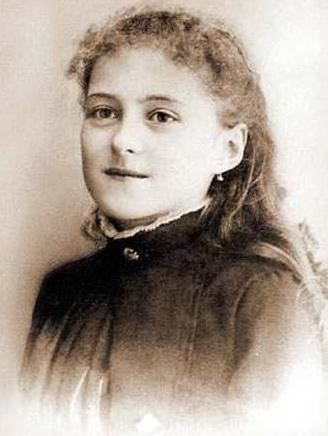
File:Teresa13anni.JPG
Thérèse of Lisieux
Age 13


Monday, October 01, 2012
St. Thérèse of Lisieux
(1873-1897)
Listen to Saint of the Day
"I prefer the monotony of obscure sacrifice to all ecstasies. To pick up a pin for love can convert a soul." These are the words of Theresa of the Child Jesus, a Carmelite nun called the "Little Flower," who lived a cloistered life of obscurity in the convent of Lisieux, France. [In French-speaking areas, she is known as Thérèse of Lisieux.] And her preference for hidden sacrifice did indeed convert souls. Few saints of God are more popular than this young nun. Her autobiography, The Story of a Soul, is read and loved throughout the world. Thérèse Martin entered the convent at the age of 15 and died in 1897 at the age of 24.

Life in a Carmelite convent is indeed uneventful and consists mainly of prayer and hard domestic work. But Thérèse possessed that holy insight that redeems the time, however dull that time may be. She saw in quiet suffering redemptive suffering, suffering that was indeed her apostolate. Thérèse said she came to the Carmel convent "to save souls and pray for priests." And shortly before she died, she wrote: "I want to spend my heaven doing good on earth."
On October 19, 1997, Pope John Paul II proclaimed her a Doctor of the Church, the third woman to be so recognized in light of her holiness and the influence of her teaching on spirituality in the Church.

***

Saint Thérèse's Wikipedia article reveals a certain "bipolarity" typical of many saints. But eventually peace came to this simple soul who dedicated her life to small acts of love. http://en.wikipedia.org/wiki/Th%C3%A9r%C3%A8se_of_Lisieux   


Gas Tax, By State. Another Revealing Blue/Red Map.


With few exceptions, progressive states impose substantially heavier gas taxes, whereas America's bigoted backwaters impose much lighter taxes.

In government (as in life) you get what you can pay for.

***

Consider the use of tax codes as effective means to achieve political goals:
http://www.bbc.co.uk/news/magazine-17027990
(At this webpage, word-search "Ireland.")


Red State - Blue State. An Enlightening Oversimplification.

What Your Beer Says About Your Politics


***

beer chart.jpg

Credit: Tracey Robinson, NMRPP

September 27, 2012 | 12:00 p.m.

Americans who most often drink Dos Equis are in the middle-of-the-road while drinkers of Heineken's flagship brand are strongly Democratic. Samuel Adams drinkers are strongly Republican, and more likely to vote.
Beer has a long and storied place in American presidential history and politics.

George Washington
 famously brewed it. James Madison purportedly sought to create a cabinet-level Secretary of Beer. And Franklin Delano Roosevelt helped make it legal to produce and sell (again) by championing legislation repealing Prohibition. Upon signing the bill, he reportedly said, "I think this would be a good time for a beer."
As you may have heard, our current president likes his beer, too. Earlier this month, the ObamaWhite House released two official recipes of its own in a blog post entitled "Ale to the Chief."
Of course, this savvy election-year move was not the first time Obama has played the "beer card." In 2009, he famously hosted a "Beer Summit" at the White House to help quell racial tensions.
Beer is also a staple on the presidential campaign trail, with candidates often visiting pubs to show they understand the common man. Similarly, pollsters sometimes ask the question, "Who would you rather have a beer with?" to gauge which candidate has the likeability edge.

Last week, beer poured into presidential politics in an unprecedented way when the beverage's most famous personality - the Most Interesting Man in the World - hosted an Obama fundraiser. You've likely seen him in ads for Mexican beer Dos Equis. His real name is Jonathan Goldsmith.
Some Dos Equis fans were not happy about the fundraiser and expressed their displeasure on the beer's Facebook page, according to Ad Age.
"Mr. Goldsmith's opinions and views are strictly his own, and do not represent those of Dos Equis," said Heineken USA, which imports Dos Equis, in a statement seeking to head off political blow-back.
Clearly, the Most Interesting Man in the World, who "once had an awkward moment, just to see how it feels," has created an awkward moment for the brewing company.
Should Heineken be worried about damage to one of its flagship brands?
(RELATED: What Your Favorite Beer Says About Your Politics)
Based on the partisanship of beer drinkers, they are wise to be in damage control mode.
We've analyzed Scarborough Research data, which includes 200,000 interviews with American adults, to determine the politics of beer drinkers.
As the bubble chart shows, Dos Equis is a bipartisan brew - Republicans and Democrats both like to drink it. So Mr. Goldsmith's public foray into the 2012 race could alienate a large share of Dos Equis fans.
Ironically, this is in contrast to its corporate sister Heineken, which as it turns out is the most Democratic beer of all. On the other hand, Republicans love their Coors Light and favor Sam Adams, which is brewed just a few miles away from Romney campaign headquarters and whose namesake was an original tea partier.
Dos Equis is not the first - and won't be the last - brand to find itself in a political pickle. From Chick-fil-A to Susan G. Komen to the pizza owner who recently hugged the president, the fallout depends on media coverage, the brand's response, and the political values of its customers.
We continue to advise big brands - who spend millions on consumer research - to make the investment to know where their fans stand politically and to put in safeguards to mitigate a political firestorm.
That being said, the best advice we can give: Stay nonpartisan, my friends.
Will Feltus is the Senior Vice President for media research and planning at National Media in Alexandria, Virginia. Mike Shannon is a partner at the consulting firm Vianovo in Austin, Texas.

Welfare Recipient J.K. Rowling: "I Didn't Build This."


Author J.K. Rowling (Paul Hackett/Reuters)
Once a financially strapped single mom, Rowling penned her way to literary fame and became a billionaire in the process. But she says she doesn’t relate to the feeling of many American conservatives that everything they have they can look at and feel, “We built it.”
“I know that in your country at the moment, [you have] this ‘We built it’ catch phrase,” Rowling told Cynthia McFadden, referring to Republican pushback against President Obama’s more communitarian view that, as in the Bruce Springsteen song that played after the president’s speech at the Democratic National Convention, “We take care of our own.’’
(What Obama said: “If you’ve got a business — you didn’t build that. Somebody else made that happen.” For the contextualized version of Obama's statement, see http://paxonbothhouses.blogspot.com/2012/09/you-didnt-build-that-whats-missing-from.html  /// http://factcheck.org/2012/07/you-didnt-build-that-uncut-and-unedited/)
Rowling’s own feeling, she said, is that it was Britain’s government services that allowed all her industry to pay off.
“I worked extremely hard… I take credit for the work. But I received a free education. I received free health care… I’m unapologetic about saying this,” she added. “I had pneumonia when my daughter was under one year old. If we hadn’t had free health care in this country, God only knows what would have happened to either of us. I am proud of having done what I’ve done. Very proud. But. I do take issue – and this does go to the heart of this book, which is why I have to say it—with anyone who truly feels it’s a 100 percent down to them.”
In fact, wealth felt like an interloper at first, an intruder that interrupted the life Rowling knew.
“Honestly, the shift was so dramatic,” she tells McFadden. “I found it very disorientating. I felt guilty, strange, out of order. And now I feel a bit more grown up about it. And I think, no, I don’t feel guilty. I can do great stuff with this money.”
As she and her husband Neil Murray raise their family in Scotland, Rowling says their lessons to their children include discovering their gifts. “For us, finding out what you’re good at, and doing it to the best of your ability, is the route to self-respect,” she says. “And I would be, as my children well know, extremely disappointed, and I would feel that I had failed, if I turned out individuals who felt their contributions to society should be simply to consume.”
Rowling’s words won’t make the wealth wizards happy, needless to say — and already, she’s been criticized for peddling her political views.
According to journalist Daniel Greenfield in FrontPageMag, Rowling is the “British Elizabeth Warren.” The “shrill, left-wing screed,” otherwise known as Rowling’s “The Casual Vacancy,” apparently inspired Greenfield to give Rowling a name change and compare her to the Massachusetts Democrat.
The very adult-themed story, which has gotten mixed reviews, takes place in the imaginary Pagford, an English village at war with itself. Expect drugs, sex, along with marital, family and economic class disputes in this story.
The novel was No. 1 on Amazon before its release, but Rowling told McFadden, that she realizes “The Casual Vacancy” may not touch the pinnacles of the Harry Potter books. But having already sold 450 million books, no wonder she feels free to write what she wants — and say what she wants, too.
Judy Howard Ellis is a Dallas-based creative consultant for entrepreneurs and the author of “Fall of the Savior-King,” a fantasy novel inspired by the Book of Genesis. Follow her on Twitter: @JudyHowardEllis
J.K. Rowling's Harvard Commencement Address

Commencement Address (video)
https://vimeo.com/1711302

J.K. Rowling, author of the best-selling Harry Potter book series, delivers her Commencement Address, “The Fringe Benefits of Failure, and the Importance of Imagination,” at the Annual Meeting of the Harvard Alumni Association. (via harvardmagazine.com)


Ryan-Romney Refuse To Discuss Their Destructive (Or Non-Existent) Specifics.

"Paul Ryan: Giving specifics would ‘take me too long’"


On Fox News Sunday, Rep. Paul Ryan claimed that Americans don’t know enough about what a Romney-Ryan presidency would do, which explains the campaign’s current troubles. But when Chris Wallace pressed Ryan to discuss the specifics of the Romney-Ryan tax plan, the mathematics of which have confounded non-partisan experts, he refused even to say how much the tax cuts the ticket has proposed would cost.(Alan... Emphasis mine.)
Everyone expects Mitt Romney to bob and weave around basic questions he doesn’t want to answer. But Ryan makes such a show about telling hard truths. Turns out Ryan’s self-righteousness has mainly served to make it more insulting when he bobs and weaves himself.

“It would take me too long to go through all of the math,” Ryan explained Sunday morning. But Wallace wasn’t asking for “all” of the math, just basic numbers. As usual with the GOP ticket, the only specific figure Ryan wanted to discuss was how much he and Romney want to drop tax rates. Wallace repeatedly asked Ryan whether Romney’s proposed tax cuts would cost $5 trillion, a question meant to establish one side of the budget equation before moving to a discussion of how Romney would pay for the cuts. But Ryan repeatedly refused to go through the addition and subtraction, instead insisting that the numbers eventually come out in his favor — Romney’s proposed tax cuts would cost nothing, he said, because Romney would offset them by cutting loopholes, primarily for upper incomes. (Alan... The only places sufficient money can be cut are Social Security, Medicare and Defense. Romney promises to increase Defense spending. Romney is committed to the repeal of Obamacare which will re-add $716 billion to the national debt. And Social Security? Duh.)
But which loopholes, and where does Romney draw the line between middle- and upper-income Americans? Ryan had nothing too specific there, either. The best he could do was repeat the nice-sounding logic of the Romney-Ryan plan:
You can lower tax rates 20 percent across the board by closing loopholes and still have preferences for the middle class for things like charitable deductions, home purchases, for health care. What we’re saying is people are going to get lower tax rates and therefore they will not send as much money to Washington.
Wallace went on to ask Ryan what Romney’s highest priority would be if the GOP ticket’s tax plan didn’t turn out to be revenue-neutral. Ryan answered that “keeping tax rates down” is “more important than anything.”

(Alan... See "A Dogma To Wreck The Country" - http://paxonbothhouses.blogspot.com/2011/11/daily-dose-112611-niall-ferguson-dogma.html)

Since Ryan kept insisting that he and Romney need not make a choice between tax cuts and, say, controlling the deficit, he probably didn’t mean for his statement to sound ominous. But since he merely said — and did not show — that Romney’s math could add up, ominous his statement was.
Wallace should have followed up with a question about how, even if Romney and Ryan managed to cut taxes and kept federal revenue where it is, they could then plausibly fix America’s long-term budget mess without additional money. Then again, Ryan didn’t seem to be in the mood for any hard truth-telling.
By   |  09/30/2012